Getting into home brewing is easier than it’s ever been, but choosing the right starter kit from the dozens available in the UK market can feel overwhelming. Some kits include everything you need for your first brew, others leave out crucial items, and the quality varies enormously. If you’re brand new to brewing, our home brewing for beginners guide explains the process before you buy. We’ve bought, unboxed, and brewed with the most popular home brewing starter kits available in the UK in 2026, covering everything from budget-friendly beginner bundles to more advanced setups. Home brewing for personal use is perfectly legal in the UK for those ready to invest in quality from the start. Every kit here has been evaluated on what’s actually included, the quality of the components, and how good the beer is that comes out the other end.
What Should a Good Starter Kit Include?
Before looking at specific kits, it’s important to know what you actually need to brew your first batch. A complete starter kit should include — at minimum — these items:
- Fermenting vessel (FV) — food-grade plastic bucket, usually 25 or 30 litres, with a lid fitted with a grommet for the airlock
- Airlock — allows CO2 to escape during fermentation while keeping air and contaminants out
- Siphon tube — for transferring beer from fermenter to bottles without disturbing sediment; ideally with an auto-siphon or bottling wand
- Hydrometer — essential for measuring gravity (sugar content) to confirm fermentation is complete and calculate ABV
- Thermometer — for checking wort temperature before pitching yeast
- Sanitiser — a no-rinse brewing sanitiser; this is the most important consumable in the entire process
- Mixing spoon — long-handled, food-grade plastic; a kitchen spoon doesn’t reach the bottom of a fermenting bucket
- Beer kit or ingredients — some starter kits include a beer kit, others don’t; check before buying
Items often missing from starter kits but still needed:
- Bottles and caps — you’ll need about 40 x 500ml bottles for a standard 23-litre batch; some kits include them, most don’t
- Capping tool — a hand capper costs about £8-12; essential unless your kit includes PET (plastic) bottles with screw caps
- Priming sugar — for carbonating bottled beer; some kits include this, many don’t
Best Budget Starter Kit: BrewUK Complete Starter Kit
Price: Around £45-55 (without beer kit) | £65-75 (with beer kit)
BrewUK’s starter kit has been a staple recommendation in UK brewing forums for years, and the 2026 version continues to offer excellent value. The kit includes a 25-litre fermenting bucket with lid and airlock, a siphon tube with a simple racking cane, a hydrometer and trial jar, a thermometer, a long-handled spoon, and a sachet of no-rinse sanitiser. The “with beer kit” version typically includes a Mangrove Jack’s or Woodforde’s kit — decent quality options that produce genuinely drinkable first brews.
What we like about this kit:
- Thorough inclusion list — unlike some budget kits, it includes the hydrometer and thermometer that others leave out
- Quality fermenter — the bucket is thick-walled and feels robust; the lid seals well and the grommet holds the airlock firmly
- Good instructions — the included guide is clear, step-by-step, and written for absolute beginners
- Sensible beer kit options — they pair it with decent mid-range kits, not the cheapest options available
Where it falls short: the siphon is a basic rigid racking cane rather than an auto-siphon, which is fiddlier to use. Bottles, caps, and capper are not included. The single sachet of sanitiser will last one brew — you’ll need to buy more for subsequent batches.
Verdict: The best option for someone who wants to try brewing without a major financial commitment. It has everything you need (minus bottles) to produce a good first batch.
Best Mid-Range Starter Kit: The Malt Miller Starter Equipment Pack
Price: Around £75-90 (equipment only)
The Malt Miller is one of the UK’s most respected home brew suppliers, and their starter pack reflects that reputation. This kit steps up from budget options with really better components that you won’t need to upgrade for a long time. It includes a 30-litre fermenting bucket (the extra 5 litres of headroom over 25-litre buckets makes a real difference during vigorous fermentation), a proper auto-siphon with silicone tubing, a hydrometer with trial jar, a stick-on LCD thermometer, a long-handled brewing spoon, and a generous supply of Chemsan no-rinse sanitiser.
What sets it apart:
- Auto-siphon included — this is a significant upgrade over a basic racking cane; it starts the siphon with a single pump action, making transfers cleaner and easier with less risk of oxidation
- 30-litre fermenter — the extra headroom prevents the foam (krausen) from clogging the airlock during vigorous fermentation; sounds minor but avoids a messy and common beginner problem
- Silicone tubing — easier to clean and more durable than standard PVC tubing; it doesn’t retain odours or stains
- Expert support — The Malt Miller’s customer service is truly excellent; they respond to questions from beginners with patience and helpfulness
This kit doesn’t include a beer kit, bottles, or a capper — you’ll need to add those separately. The Malt Miller sells their own recipe kits (both extract and all-grain) that are well-designed and come with clear instructions. Their “Session IPA” and “Best Bitter” extract kits are ideal companions for this equipment pack.
Verdict: The sweet spot for someone who’s fairly sure they want to stick with brewing. The quality of the components means you won’t need to replace anything as you progress from kit brewing to extract and beyond.
Best Premium Starter Kit: BrewBarrel Craft Beer Brewing Kit
Price: Around £60-70
The BrewBarrel takes a completely different approach to starter kits. Instead of a bucket and bottles, everything happens inside a single 5-litre pressurised keg. Once you outgrow this, kegging your homebrew is the natural next step. You add water and the included ingredients, seal it, and the beer ferments, carbonates, and dispenses from the same container. It’s the closest thing to a “plug and play” brewing experience available.
The kit includes the 5-litre keg with built-in tap, pre-measured ingredients (malt extract, hops, and yeast), a CO2 cartridge for dispensing, and step-by-step instructions. You actually need nothing else except water and a bit of patience.
- Incredibly simple — truly a one-vessel system; no separate fermenter, no siphoning, no bottling; you pour the finished beer from the tap
- No bottles needed — the keg is both the fermenter and the serving vessel; this eliminates the most tedious part of home brewing for many people
- Makes a good gift — the packaging is attractive and the simplicity makes it really accessible to someone with zero brewing knowledge
- Quick turnaround — the smaller volume (5 litres vs the standard 23 litres) means fermentation completes faster; you can be drinking your beer in about 10-14 days
The trade-offs are significant, though. Five litres is only about 9 pints — a fraction of what a standard batch produces. The cost per pint is much higher than traditional brewing. You have minimal control over the recipe, and the smaller volume amplifies any temperature control issues. It’s also a dead end in terms of brewing progression — the skills don’t transfer directly to traditional brewing methods. For a related angle, see our Best Beer Recipe Kits 2026 UK: IPA, Stout & Lager guide.
Verdict: Excellent as a taster experience or gift, but not the best route into serious home brewing. If you enjoy it and want to continue, you’ll end up buying a proper setup anyway.
Best All-In-One System: BrewZilla 35L Gen 4
Price: Around £330-380
This recommendation comes with a caveat: the BrewZilla is not a “starter” kit in the traditional sense. It’s a serious piece of brewing equipment aimed at those who want to skip kit and extract brewing and go straight to all-grain. We’re including it because it represents truly excellent value for what it offers, and for a certain type of beginner — someone with a bit of extra budget, a keen interest in the science of brewing, and no interest in “starting small” — it makes sense to invest properly from the start.
The BrewZilla is an electric all-in-one brewing system that handles mashing, boiling, and cooling in a single vessel. It has a built-in electric heating element, a recirculating pump for even mashing temperatures, a digital temperature controller, and a built-in tap for transferring wort. You still need a separate fermenter, but the BrewZilla handles everything from raw grain to cooled wort in one unit. Our Best Budget Homebrew Kits Under £50 2026 guide is useful alongside this.
- All-grain from day one — no need to graduate through kit and extract brewing if you want the full experience straight away
- Excellent build quality — stainless steel construction with well-designed components; feels like professional equipment
- Digital temperature control — programmable step mashing with precise temperature management; set it and it maintains the temperature automatically
- Good community support — the BrewZilla has a massive user community in the UK; YouTube tutorials, forum discussions, and recipe adaptations are abundantly available
- Compact for an all-grain system — traditional three-vessel all-grain setups take up half a garage; the BrewZilla fits on a kitchen worktop (though you’ll want ventilation for the boil steam)
You’ll need to add a fermenter, bottles or a keg system, a hydrometer, sanitiser, and ingredients — so the total startup cost is closer to £450-500. That’s a significant investment for a hobby you haven’t tried yet, which is why we suggest it for people who’ve done their research and are committed to brewing properly.
Verdict: The best value all-in-one brewing system available in the UK. Not for tentative beginners, but excellent for enthusiastic ones.
Best for Kegging: Kegland Starter Keg Kit
Price: Around £120-150 (keg system only, without brewing equipment)
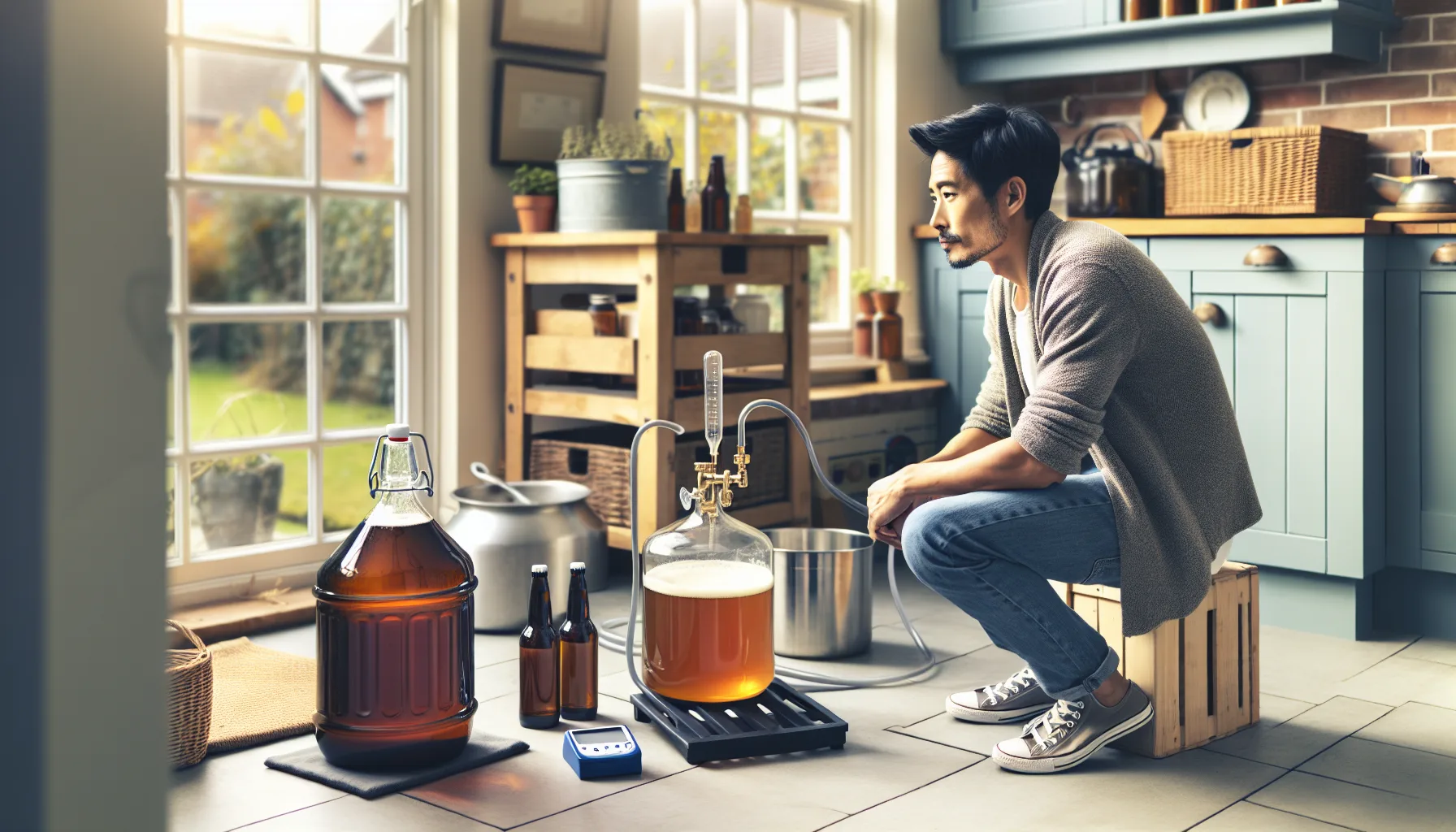
While not a brewing starter kit per se, a kegging setup is worth mentioning because it solves the biggest pain point in home brewing: bottling. Cleaning, sanitising, filling, and capping 40 individual bottles is tedious, time-consuming, and the stage at which most oxidation damage occurs. Kegging replaces all of that with a single vessel that you fill once, carbonate with CO2, and pour from like a pub tap.
The Kegland starter keg kit includes a 19-litre Cornelius-style (Corny) keg, a CO2 regulator, a small CO2 cylinder, gas and liquid disconnects, and a tap or picnic tap for serving. You transfer your finished beer into the keg, apply CO2 pressure (about 10-12 PSI at fridge temperature), and within a few days you have perfectly carbonated, pub-quality beer on tap. We cover a similar decision in Best Homebrew Kegging Kits 2026 UK: Corny & Mini Kegs.
- Eliminates bottling entirely — for many brewers, this alone justifies the cost; filling one keg takes 5 minutes vs an hour+ for bottling
- Better beer quality — far less oxygen exposure during transfer means fresher-tasting beer with a longer shelf life
- Forced carbonation — more consistent and controllable than bottle conditioning; you can adjust carbonation levels to suit different styles
- Looks impressive — there’s something undeniably satisfying about pouring homemade beer from a proper tap
The downsides: you need a fridge or kegerator to keep the keg cold (a second-hand fridge dedicated to beer is the usual solution), the initial outlay is higher than bottling, and CO2 cylinders need periodic refilling (homebrew shops and some welding supply stores do this). It’s an upgrade rather than a starting point, but many brewers wish they’d switched to kegging sooner.
Verdict: Not a first purchase, but the single best upgrade you can make to your brewing setup once you’ve got a few batches under your belt.
Where to Buy Home Brewing Equipment in the UK
The UK has a healthy home brew retail scene, both online and in physical shops. Here are the most reliable options:
- The Malt Miller (themaltmiller.co.uk) — arguably the UK’s best online home brew shop; excellent range, competitive prices, and outstanding customer service; particularly strong on all-grain ingredients and recipe kits
- BrewUK (brewuk.co.uk) — great range of starter kits and equipment; reliable delivery and good prices; strong on kit and extract brewing supplies
- Geterbrewed (geterbrewed.com) — Northern Ireland-based with excellent range and service; particularly good for yeast (they stock a wide range of Lallemand, Fermentis, and Mangrove Jack’s strains) and hops
- The Home Brew Shop (the-home-brew-shop.co.uk) — one of the oldest online suppliers; huge range and helpful staff; good for finding specific or unusual ingredients
- Local home brew shops — if you have one nearby, support it; the advice from experienced staff is invaluable for beginners, and being able to see and handle equipment before buying is helpful
Amazon sells some brewing equipment, but the specialist retailers above generally offer better prices, more knowledgeable service, and a wider range of brewing-specific products. They also stock ingredients that Amazon typically doesn’t — fresh hops, liquid yeast, and speciality malts.
How to Choose the Right Kit for You
The right starter kit depends on your budget, your space, and how seriously you think you’ll pursue the hobby. Here’s a quick decision framework:
- Just curious, minimal budget (£50-70): Go with the BrewUK Complete Starter Kit with an included beer kit; it’s everything you need for a first batch at the lowest sensible price point
- Fairly keen, moderate budget (£80-120): The Malt Miller Starter Equipment Pack gives you better components that last; add a quality beer kit and bottles separately
- Buying as a gift for someone (£60-70): The BrewBarrel is self-contained, attractive, and actually simple to use; perfect for someone who’s never brewed
- Committed and ambitious (£350-500): The BrewZilla plus a fermenter and basic supplies gets you into all-grain brewing from day one; a bigger investment but one that skips the intermediate steps
Frequently Asked Questions
What is the best home brewing starter kit in the UK? For most beginners, the Youngs American IPA Kit or a similar premium ingredient kit paired with basic equipment is the best starting point. If you want everything in one box, the Woodfordes Wherry kit is a popular and reliable choice that produces excellent results on a first brew. For independent guidance, check The Homebrew Forum guidance.
How much does it cost to start home brewing? A basic home brewing starter kit costs between £40 and £80, which includes a fermenter, bottling equipment, and your first batch of ingredients. More advanced setups with better temperature control can cost £100-200. An all-in-one brewing system for all-grain brewing starts at around £300.
Is home brewing legal in the UK? Yes, home brewing beer and wine for personal consumption is completely legal in the UK with no licence required. You cannot sell your homebrew without the appropriate HMRC excise licence. There is no limit on how much you can brew for personal use.
How long does it take to brew beer at home? The brewing process itself takes 3-6 hours depending on your method. Fermentation then takes 1-2 weeks, followed by 1-2 weeks of carbonation in bottles or kegs. From brew day to drinking, expect around 3-4 weeks for most ale styles and 6-8 weeks for lagers.
What equipment do I need to start home brewing? At minimum, you need a fermenter with airlock, a siphon or bottling wand, bottles with caps or a capper, a sanitiser, and a hydrometer. Most starter kits include all of these. A thermometer and a large pot are useful additions if your kit does not include them.
The Bottom Line
The best home brewing starter kit is the one that gets you brewing. Overthinking the purchase is a common trap — people spend weeks researching equipment and never actually make any beer. At the budget end, the difference between starter kits is quite small; they all include the same basic components, and they all produce beer. What matters far more is your process — proper sanitisation, temperature control, and patience — than whether your fermenting bucket cost £15 or £25.
If you’re really uncertain about whether you’ll enjoy brewing, start with a budget kit. You’ll lose £50-60 if you decide it’s not for you — a cheap experiment. If you’re already reading brewing forums, watching YouTube tutorials, and fantasising about your own IPA recipe, consider investing in better equipment from the start. You’ll use it for years, and the per-batch economics of home brewing mean the equipment pays for itself surprisingly quickly. Either way, stop researching and start brewing. Your first batch is waiting.